


About Us
What we value most at Sun Select is fundamental to the way we do business. It’s the reason why Sun Select partners only with tried and trusted solar providers who sell and install the best solar panels in Australia at the lowest prices. What do we and they both value? You, the customer.
Contact NowContact Info
- Suite No 204, 10-12 Flushcombe Road Blacktown NSW 2148
- 8B/386 Wanneroo Rd, Westminster WA 6061
- 1300 867 353
- [email protected]

OUR SOLAR ENERGY BLOGS
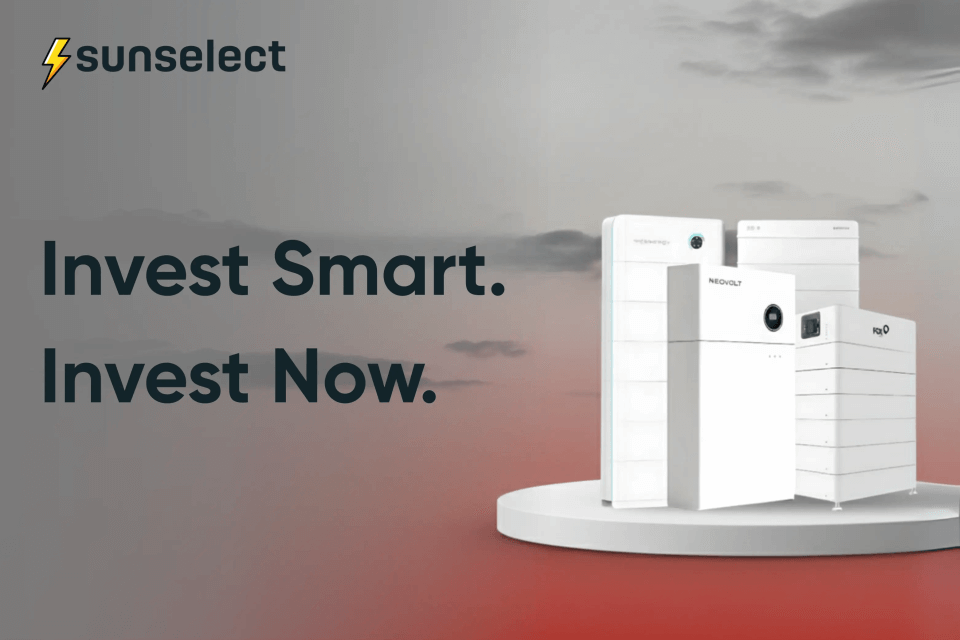
The Best Time to Invest in Solar Battery Storage in Australia is Now
26 September, 2025.Australia is at a genuine inflection point for household solar batteries. Falling costs, new federal and state incentives, growing grid stress, and the rise of Virtual Power Plants (VPPs) have combined to make battery storage a far more practical and financially sensible, a choice for many homeowners and small businesses in 2025. Below I unpack the full picture: the policy context, the financial case, technical maturity, grid and resilience benefits, how to evaluate options, and practical next steps. I’ve cited the most important sources so you can follow up on the specific programs and numbers.
1. The policy moment: large, visible incentives that cut upfront cost
In 2025 the Australian Government rolled out the Cheaper Home Batteries Program, which provides a substantial discount (around 30% in the program’s implementation) on eligible small-scale battery systems. The rebate is delivered via participating installers and is intended to bring the up-front cost of batteries down markedly for households and small businesses. State governments (e.g., NSW, WA, Victoria) have also layered complementary incentives and VPP connection payments, meaning in many places you can stack federal and state support to reduce net cost even further.
Why this matters: prior to these programs, the high capital cost was the single largest barrier to adoption. A reliable ~30% discount changes payback math for a large segment of households.
2. Demand and market signals: uptake is surging
Installation data and industry reporting in 2025 show battery uptake accelerating strongly, monthly installation numbers hit multi-year highs, and analysis from independent trackers and industry bodies reports a marked surge in consumer demand since the rebate announcement. That momentum matters because a larger market attracts more competitive pricing, broader product availability, and better installer ecosystems.
3. The financial case: lower bills, faster payback than before
There are three revenue/cost-savings streams that make batteries financially attractive today:
- Self-consumption value: store daytime solar for evening peak usage when grid electricity prices (or peak rates) are higher.
- Grid export/time-of-use arbitrage: charge when rooftop solar or off-peak tariffs are cheap; discharge during expensive peak periods.
- VPP payments: sign up to a VPP to receive upfront connection payments and ongoing payments when your battery helps the grid. Several state programs specifically incentivise VPP connection.
Practically, with the federal rebate and state top-ups, the typical payback period for many households is now often measured in years rather than decades and for high-usage or time-of-use tariff households, the economics are especially compelling. (Exact payback will depend on household consumption profile, battery size and usable capacity, retail tariff structure, and whether the household participates in a VPP.)
4. Technology maturity & falling costs
Battery chemistry (mostly lithium-ion for residential systems), battery management systems, inverter integration, and software for energy management have matured rapidly. Unit prices (per kWh usable capacity) have come down thanks to manufacturing scale and competition among major suppliers, while warranties and expected lifetimes have improved. That means households get more usable life and clearer reliability guarantees than early adopters did. This maturity lowers both the technical and perceived risk of buying a battery today.
5. Grid benefits and resilience: more than private gain
Home batteries aren’t only a household benefit when aggregated via VPPs they provide grid-scale services such as frequency control, network peak shaving, and faster response than many traditional generation assets. Governments and network operators see distributed batteries as a cost-effective way to support reliability and integrate more renewables without building as much new centralised generation or costly network upgrades. For individual households, batteries also provide resilience against outages and price spikes.
6. Virtual Power Plants (VPPs): an important extra income stream
VPPs let battery owners earn payments while their batteries are coordinated with many others to provide grid services. Some state incentives explicitly reward households that join approved VPPs with upfront bonuses and ongoing payments. That both improves household returns and helps the community by enabling distributed energy to meet peak demand. But VPP participation terms vary so compare offers carefully (how much of your capacity they can access, when, and how you’re paid).
7. Environmental and social case
Adding battery storage increases the proportion of locally used solar energy and reduces reliance on fossil-fuel generation during peak hours. This lowers household emissions and helps Australia decarbonise the grid. At scale, distributed batteries can reduce the need for new peaking plants and lower emissions from backup generation. The federal program emphasizes the program’s climate and affordability benefits as complementary goals.
8. How to choose the right battery (practical checklist)
- Capacity vs usable kWh: look at usable capacity (not just nominal) and check whether the system’s usable capacity is within the rebate’s eligible cap (often the first 50 kWh usable is eligible under current rules).
- Round-trip efficiency: higher efficiency means more of your stored energy is usable.
- Depth of discharge & cycles: these impacts how the battery will age and how much useful life you’ll get.
- Warranty & performance guarantees: check cycle and capacity guarantees (years and cycles).
- VPP readiness & communications: if you plan to join a VPP, ensure the inverter/control system is supported by common VPP providers. Many rebate programs favour or require VPP-ready models.
- Installer accreditation & consumer protections: use accredited installers and read contract terms about performance, service response, and consumer guarantees.
9. Real-world example (illustrative)
A typical modern home with a 6–10 kWh usable battery that uses solar heavily in daytime and consumes most electricity in the evening could see:
- Lower evening bills by displacing expensive grid power with stored solar,
- Upfront rebate reducing purchase cost by 30% (subject to eligibility and caps),
- VPP connection bonus in some states,
- Payback in a plausible timeframe for mid-to-high usage households (exact numbers depend on tariffs and usage).
(Use an installer or an online solar/battery calculator to input your local retail tariff and consumption to get an exact payback estimate.)
10. Risks and things to watch
- Policy changes: Incentives can evolve; check official government pages for the latest eligibility details and caps.
- Product mismatch: An undersized battery won’t meaningfully change bills; an oversized battery might be uneconomical. Size to your daily usage pattern.
- VPP contract fine print: Check how often your battery can be used by the VPP and whether that affects your own availability in critical times.
11. Next steps (practical guide)
- Check your eligibility and the current rebate details on the federal site and your state energy office.
- Gather your electricity bills (12 months if possible) and note any time-of-use periods.
- Get quotes from at least 3 accredited installers and ask for full system specs (usable kWh, inverter type, round-trip efficiency, warranty cycles).
- Compare VPP offers separately and see who pays what, and when they can access your battery.
- If you’re comfortable, schedule an installation window, with rebates applied via participating retailers/installers, the upfront cost will be lower than it was before these programs.
Conclusion
Australia stands at the forefront of a clean energy transition, and 2025 has brought a unique window of opportunity for homeowners to take advantage of solar battery adoption. With the federal Cheaper Home Batteries Program, state-based rebates, and Virtual Power Plant incentives driving down upfront costs, batteries have become more financially accessible than ever before. At the same time, advancements in technology, longer warranties, and falling per-kWh costs mean households can now enjoy greater reliability and faster payback periods.
Taken together, policy support (notably the Cheaper Home Batteries Program), falling hardware costs, stronger market competition, VPP incentives, and real grid benefits make 2025 a much stronger year to adopt household battery storage than previous years. For many households, particularly those on time-of-use tariffs, with significant evening demand, or those who value blackout resilience, a battery added to an existing rooftop solar system can now deliver financial, reliability, and environmental benefits in a realistic timeframe.
Reach Out to SunSelect at 1300 867 353 for Expert Guidance and Money-Saving Options.
Explore the Reviews from Our Delighted Customers on ProductReview.com.au.



